



Podcast: Investor pathway to decarboniseBY THE GREENER WAY | TUESDAY, 14 JUL 2026 8:54AM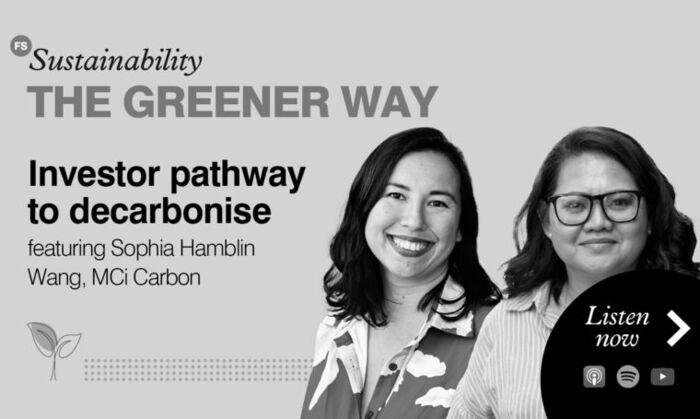 Can captured carbon dioxide be transformed into valuable commercial products, and could this help heavy industries such as cement, steel and mining accelerate their path to net zero while creating new business opportunities? Related News |


Editor's Choice
Hearts & Minds,Third Link Growth Fund merge
Hearts & Minds Investments and Third Link Growth Fund have announced a merger, with Hearts & Minds taking over the role of investment management of the fund.
ASFI launches physical risk inclusion in sustainable finance taxonomy
The Australian Sustainable Finance Institute (ASFI) has launched a scoping project to expand Australian Sustainable Finance Taxonomy to climate change adaptation and resilience.
New Forests eyes forestry plantations
New Forests is set to acquire the forestry plantations of Associated Kiln Driers (AKD) and Heywood Plantations, the approval of which currently sits before the Australian Competition and Consumer Commission (ACCC).
Flexible work fails to follow women into leadership
While a greater number of women are advancing into management roles, inflexible leadership positions and unequal caring responsibilities are forcing more women to leave senior positions.
Videos
Brought to you by ![]()

Further Reading
Whitepapers
Modern slavery in the geopolitical crossfire
When investors frame the conversation about the risks of modern slavery, we tend to cite a common set of facts and a common set of arguments as to why ...

What ACCR v Santos means for your climate disclosures
The Federal Court has dismissed greenwashing claims brought by the Australasian Centre for Corporate Responsibility (ACCR) against Santos.

Materiality is not a single judgment: It is a governance system
Much has been written about sustainability materiality in recent years. The more fundamental problem is that materiality is still treated as a single ...

Roundtable reflections: Is ESG dead?
"Is ESG dead?" we asked at our recent Responsible Investors (RI) roundtable in May this year. Short answer: no.
Expert Feed
Navigating the climate and biodiversity frontier
Climate change and biodiversity loss were once seen as niche sustainability concerns. Today they sit at the centre of financial analysis - understanding ...

Embracing complexity for sustainable returns
Ausbil says investors who embrace the complexity of dynamic company ESG, and sustainability profiles may be better placed to assess long-term risks and ...

Australia's social media age ban: A digital turning point for society and investment markets
In a global first and a warning shot for platforms, at the end of 2025 Australia became the first country to ban under-16s from social media, with penalties ...
How economics and energy security are driving the next phase of the energy transition
Looking ahead, the next phase of the energy transition will be defined by practical system build-out rather than headline climate commitments.
ACCESS MORE CONTENT
Financial Standard
Australia's most-read trade publication for wealth management professionals.