



Podcast: Next wave in ocean investingBY THE GREENER WAY | TUESDAY, 8 SEP 2026 9:36AM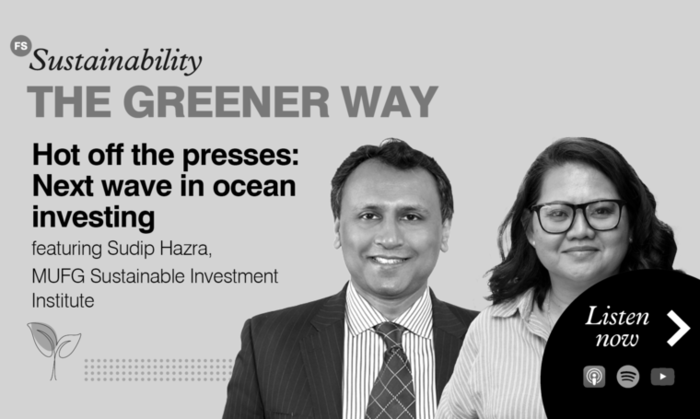 🌿 Why investors may be overlooking one of the biggest risks in their portfolios ❓ Question: If the ocean underpins climate stability, food security, global trade and biodiversity, why has it remained largely absent from investment frameworks, and how can investors better account for ocean-related risks and opportunities in their portfolios? ✅ Answer: According to Sudip Hazra, director of the First Sentier MUFG Sustainable Investment Institute, the ocean is the world's largest natural asset class but remains one of the least understood by investors. Many investors already have significant exposure to ocean-related risks because industries across food production, tourism, shipping, infrastructure and consumer goods depend on healthy marine ecosystems. Hazra argues that oceans should be viewed as critical economic infrastructure rather than an environmental externality. By better understanding these dependencies, investors can improve risk management, identify new opportunities and support the transition to a more sustainable blue economy. 🌟 The ocean underpins far more of the economy than many investors realise Hazra explains that ocean health influences a wide range of industries, even those not traditionally associated with marine assets. Every diversified investment portfolio is likely to contain companies that depend on oceans, waterways and marine ecosystems. Rather than sitting outside portfolios as an environmental concern, ocean-related risks and opportunities are already embedded within many existing investments. 🌟 Natural marine assets deliver significant economic value The report highlights the Great Barrier Reef as an example of a natural asset that generates substantial economic activity. Beyond tourism, marine ecosystems such as coral reefs, mangroves and seagrass meadows provide coastal protection, support fisheries, store carbon and help sustain local economies. Hazra argues these assets should be recognised as economic infrastructure rather than simply environmental features. 🌟 Ocean exposure exists across unexpected sectors Investors often assume ocean-related risks are confined to fisheries or shipping. However, Hazra points to examples such as pet food manufacturers whose supply chains depend on healthy marine biodiversity. As a result, companies in seemingly unrelated sectors are increasingly recognising the business value of maintaining healthy ocean ecosystems. 🌟 Better frameworks can improve investment decision-making To help investors identify and manage ocean-related risks, the institute developed the Ocean Framework report. The framework is designed to help investors assess dependencies, evaluate risks, engage with portfolio companies and allocate capital more effectively. It includes engagement questions and sector-specific guidance for industries with significant ocean exposure. 🌟 Super funds can help close the blue finance funding gap Hazra believes Australian super funds have an important role to play in accelerating investment into ocean-related solutions. This includes supporting investment-ready projects, improving data quality and engaging with companies on practical sustainability issues that affect marine ecosystems. Effective engagement can also influence policy outcomes and drive behavioural change across industries. 🌟 Ocean investing is closely linked to climate, biodiversity and food security Rather than being a standalone sustainability theme, ocean health supports several of the most important long-term investment trends. Hazra argues that investors focused on climate resilience, biodiversity protection, food security and long-term value creation should also consider ocean-related risks because these challenges are deeply interconnected. 🚩 A lack of data continues to limit investment One of the biggest barriers to ocean investing is the absence of consistent data and widely adopted frameworks. Investors often struggle to quantify ocean-related risks, resulting in underpricing of environmental impacts and underinvestment in solutions. Closing these data gaps is essential to improving capital allocation. 🚩 Governance remains fragmented Unlike climate reporting, ocean-related regulation and disclosure frameworks remain relatively immature. Hundreds of overlapping policies and varying levels of enforcement can create uncertainty for investors seeking clarity around risks, standards and accountability. ⚠️ Ocean-related risks may emerge sooner than investors expect Hazra cautions that ocean-related issues should not be viewed solely as long-term concerns. Marine pollution, biodiversity loss and water contamination can create immediate financial, operational and reputational risks for companies. These risks may affect supply chains, product availability and business profitability far sooner than many investors anticipate. ⚠️ Pollution and legal liabilities can become financially material The interview highlights PFAS, or "forever chemicals", as an example of how poor environmental management can lead to significant litigation risks and financial impacts. Investors who fail to understand these exposures may underestimate potential liabilities within portfolios. 🌟 Looking ahead, oceans may become an increasingly important investment theme Hazra believes investors are beginning to recognise that ocean health is fundamental to long-term economic resilience. As understanding improves and frameworks mature, investors may increasingly integrate ocean considerations into portfolio construction, stewardship activities and risk management processes. He argues that healthy oceans are not merely an environmental goal but a prerequisite for sustainable economic growth. 💡 Why it matters: Ocean health supports critical economic systems including climate regulation, food production, global trade and biodiversity. Yet despite its importance, oceans remain underrepresented within traditional investment analysis. Hazra's research suggests investors may already be exposed to significant ocean-related risks without fully recognising them. As data improves and awareness grows, the ability to identify ocean dependencies and incorporate them into investment decisions could become an increasingly important part of managing risk, protecting long-term returns and supporting a more sustainable global economy. 🎙️ Sources: Sudip Hazra, director, First Sentier MUFG Sustainable Investment Institute Michelle Baltazar, host, The Greener Way ⏱️ Timestamps: 00:00 - Why oceans should be viewed as economic infrastructure 01:15 - Introducing the Ocean Framework report 02:00 - Why investors already have ocean exposure 04:23 - Examples of ocean assets hidden in portfolios 05:28 - Coral reefs, biodiversity and business dependency 07:00 - Why oceans have been overlooked by investors 08:51 - Understanding the blue finance funding gap 10:17 - Climate change, oceans and investment implications 11:28 - How super funds can help close the funding gap 13:00 - Policy engagement and reducing marine pollution 14:37 - Responding to short-term investment concerns 15:21 - The financial risks of marine pollution 17:00 - Where investors should start integrating ocean risks 18:15 - The Ocean Framework and engagement toolkit 20:15 - Final messages for investors and super funds 🌿 We record on Gadigal Land and pay our respects to the traditional custodians of country and elders past and present. Related News |


Editor's Choice
Blackstone raises $12bn for fifth energy transition fund
Gas transition to take 'decades rather than years': UniSuper
Podcast: Urgent calls for deforestation-free lending
Anti-slavery commissioner calls for smarter due diligence for SMEs
Videos

Whitepapers

Modern slavery in the geopolitical crossfire

What ACCR v Santos means for your climate disclosures

Materiality is not a single judgment: It is a governance system

Roundtable reflections: Is ESG dead?
Expert Feed

Navigating the climate and biodiversity frontier

Embracing complexity for sustainable returns

Australia's social media age ban: A digital turning point for society and investment markets

How economics and energy security are driving the next phase of the energy transition