



Podcast: The climate capital Australia can't afford to loseBY THE GREENER WAY | TUESDAY, 29 SEP 2026 9:18AM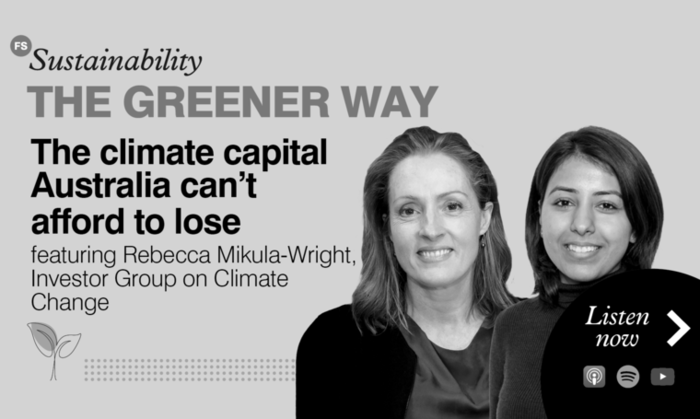
🌿 Australia's climate capital challenge: Why investors want to spend billions but can't find enough opportunities ❓ Question: Why are Australia's largest investors struggling to deploy more climate capital locally, and what needs to change to attract the investment required for the country's net-zero transition? ✅ Answer: According to Rebecca Mikula-Wright, chief executive of the Investor Group on Climate Change (IGCC), institutional investors remain highly committed to climate-related investing despite geopolitical uncertainty, energy security concerns and market volatility. Australia's superannuation funds and institutional investors increasingly view climate change as both a financial risk and a major investment opportunity. However, while investor appetite for climate solutions continues to grow, there remains a shortage of investable opportunities that meet required risk and return thresholds. Mikula-Wright argues the challenge is not a lack of capital but a lack of policy certainty, project readiness and market signals that allow large-scale investment to flow efficiently. With Australia's super funds managing approximately $4.5 trillion and the nation requiring up to $630 billion of investment to meet its 2035 climate targets, she says getting policy settings right will determine whether that capital stays in Australia or moves elsewhere. 🌟 Clean energy remains the dominant climate investment theme Renewable energy generation, transmission infrastructure and energy storage continue to attract the strongest investor interest. These sectors are viewed as critical to both emissions reduction and future energy security. 🌟 Climate adaptation is emerging as a major opportunity Investors are increasingly moving beyond mitigation and emissions reduction to focus on adaptation and resilience. Around a third of investors now view climate adaptation as an investment opportunity rather than simply a risk that must be managed. 🌟 Asia is becoming more attractive for climate capital Investor interest in climate opportunities across Asia is growing rapidly. As Australia competes for global capital, investors are increasingly evaluating overseas markets that offer stronger policy certainty and larger investment pipelines. 🌟 Energy security is reshaping investment decisions Geopolitical tensions and concerns about energy supply are reinforcing support for electrification, renewable infrastructure and low-carbon fuels. Climate investment is increasingly being viewed through a national security lens. 🌟 Climate risks are being integrated into mainstream portfolios Rather than limiting sustainability considerations to dedicated ethical funds, investors are increasingly embedding climate risks and opportunities across their entire portfolios and investment processes. 🌟 Climate adaptation finance could become a significant new asset class Historically, governments have funded adaptation projects. As private investment markets mature, opportunities are emerging in infrastructure, resilience solutions and technologies designed to address physical climate risks. 🌟 Stewardship remains a key tool for investors Shareholder engagement, voting and corporate stewardship continue to play an important role in influencing company behaviour. However, investors increasingly recognise that broader policy and market reforms are needed to drive system-wide change. 🌟 Mandatory climate reporting could improve investment decisions As climate disclosure frameworks develop, investors expect to gain better visibility into how companies identify, manage and prepare for climate-related risks and opportunities. 🚩 A shortage of investment-ready projects remains a major barrier Many investors say they want to allocate more capital but cannot find enough climate-aligned investments with suitable risk-return characteristics. This remains one of the biggest obstacles to scaling climate finance. 🚩 Policy uncertainty continues to slow capital deployment Investors remain concerned about whether climate and energy policies will remain consistent across political cycles. Without long-term certainty, capital can remain on the sidelines or move overseas. 🚩 Slow approvals and regulatory bottlenecks are creating delays Project approval processes, tax uncertainties and outdated regulatory frameworks are slowing the development of climate-related infrastructure and reducing the number of investable opportunities. 🚩 Australia faces growing competition for global capital Investors have choices about where to deploy funds. If Australia cannot create an attractive investment environment, climate capital may increasingly flow to other regions. ⚠️ Capital availability does not guarantee investment Mikula-Wright stresses that having trillions of dollars available for investment does not automatically mean that funds will be deployed. Effective policy design and implementation remain critical. ⚠️ Weak demand signals can undermine climate investment Current market incentives are not always strong enough to stimulate demand for climate solutions, making it harder for projects to achieve commercial viability. ⚠️ Delays to the energy transition could impact long-term competitiveness Failure to accelerate decarbonisation, clean energy deployment and climate adaptation may weaken Australia's ability to compete for future investment and trade opportunities. 💡 Why it matters: Climate investing is moving from a niche sustainability strategy to a mainstream capital allocation issue. Australia's largest institutional investors are signalling that significant amounts of money are available for clean energy, climate adaptation and decarbonisation projects, but that capital needs investment-ready opportunities and stable policy settings. As Australia works toward its 2035 climate goals, the ability to attract and deploy climate capital may play a crucial role in determining the country's economic competitiveness, energy security and long-term prosperity. 🎙️ Sources: Rebecca Mikula-Wright, chief executive, Investor Group on Climate Change (IGCC) Riddhima Talwani, host, The Greener Way ⏱️ Timestamps: 00:00 - Why Australia needs climate investment capital 01:03 - Where climate sits among investor priorities 02:38 - Major climate investment themes driving capital 03:13 - Growth in clean energy and adaptation investing 04:04 - Why investors are looking increasingly towards Asia 05:00 - The gap between investor appetite and available opportunities 06:02 - Policy certainty and barriers to capital deployment 07:13 - How investors are engaging with policymakers 08:16 - The shift from ethical funds to portfolio-wide ESG integration 10:02 - Stewardship, shareholder voting and climate engagement 11:42 - What investors want from mandatory climate reporting 13:10 - IGCC's policy priorities and climate agenda 14:03 - National adaptation planning and climate finance 15:08 - Clean energy, low-carbon fuels and industrial decarbonisation 16:00 - Australia's role in supporting Asia's transition 16:35 - Why policy settings will determine where capital flows 17:08 - IGCC Summit and final remarks 🌿 We record on Gadigal Land and pay our respects to the traditional custodians of Country and elders past and present. Related News |


Editor's Choice
EU proposes sustainability labels for data centres
Morgan Stanely backs Amber in €49m funding round
UBS Global Wealth Management names head of for purpose organisations
Podcast: Ethinvest on impact and shareholder activism
Videos

Whitepapers
Modern slavery in the geopolitical crossfire

What ACCR v Santos means for your climate disclosures

Materiality is not a single judgment: It is a governance system

Roundtable reflections: Is ESG dead?
Expert Feed

Australia's social media age ban: A digital turning point for society and investment markets

How economics and energy security are driving the next phase of the energy transition

Sustainability in 2025: Building resilience and navigating risks

Balancing Investor expectations with entrepreneurial growth