



Podcast: Australia's big bet on green steelBY THE GREENER WAY | TUESDAY, 4 AUG 2026 12:26PM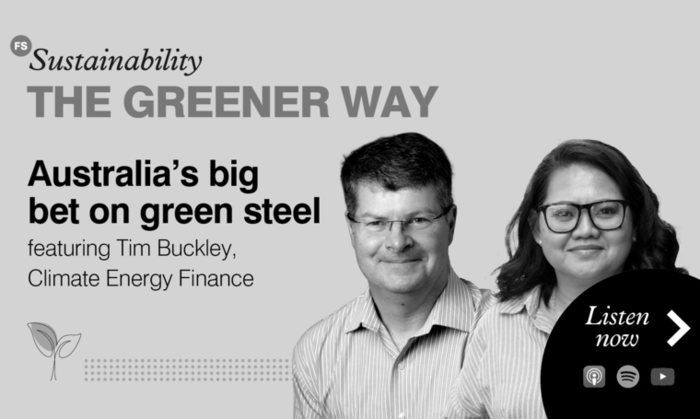 🌿 How can Australia catch up to the frontrunners in the green steel race? ❓ Question: As global demand shifts towards low-carbon industries and clean supply chains, does Australia have a realistic opportunity to move beyond exporting raw materials and become a leader in green steel manufacturing? ✅ Answer: According to Tim Buckley, founder and director of Climate Energy Finance, Australia has a once-in-a-generation opportunity to transform its economy by decarbonising the steel supply chain and building domestic green steel manufacturing. While Australia is already the world's largest exporter of iron ore, it captures very little value from processing it. Buckley argues that with the right policy settings, investment frameworks and industrial strategy, Australia can create jobs, strengthen regional economies, reduce emissions and become a major supplier of low-emissions steel in a decarbonising world. 🌟 One of the report's central themes is that Australia needs to move beyond its traditional "dig and ship" economic model. While unprocessed iron ore remains one of Australia's most valuable exports, Buckley argues that future competitive advantage will come from adding value domestically and supplying trading partners with the low-carbon products they will increasingly require. Decarbonising steelmaking represents one of the largest industrial opportunities globally, and Australia is uniquely positioned due to its iron ore resources and renewable energy potential. 🌟 Buckley believes the global transition away from fossil fuels is inevitable. The real question is whether Australia benefits from that transition or becomes one of its casualties. As one of the world's largest exporters of fossil fuels, Australia faces significant economic risks if it fails to diversify. Green steel manufacturing offers a pathway to protect export revenues while positioning the country for future growth. 🌟 Rather than immediately pursuing large-scale export ambitions, Buckley argues Australia should begin by developing domestic low-emissions steel production using electric arc furnaces. These facilities use scrap steel and renewable electricity instead of coal-intensive blast furnaces, significantly reducing emissions while creating local manufacturing capacity. He sees electric arc furnaces as a practical starting point that allows Australia to learn, build expertise and establish supply chains before scaling further. 🌟 Regional Australia could be one of the biggest beneficiaries of this transformation. Proposed electric arc furnace projects in Western Australia, Queensland and South Australia could create construction jobs, ongoing manufacturing employment and opportunities for associated industries such as recycling and renewable energy generation. Buckley argues that successful energy transition policies must provide replacement industries for coal-dependent communities rather than leaving workers behind. 🌟 Green steel is also about national resilience and supply chain security. Buckley notes growing concerns across Western economies about overreliance on offshore manufacturing. Developing domestic processing capability would not only create economic opportunities but also strengthen Australia's strategic position by reducing dependence on imported industrial products. 🚩 One major challenge is the scale of investment required. Climate Energy Finance estimates Australia will need hundreds of billions of dollars of capital to transform its economy. Buckley argues that private capital is available, but governments must provide policy certainty and strategic investment mechanisms that help crowd in private-sector funding and lower project risks. 🚩 Another challenge involves workforce transition. Communities built around coal mining, coal-fired power generation and other legacy industries face uncertainty as Australia decarbonises. Buckley stresses that political and community support for climate action depends on creating visible pathways into new industries and ensuring future jobs are located in existing regional centres wherever possible. ⚠️ Policy settings will play a critical role in determining whether Australia succeeds. Buckley highlights the need for government-backed investment vehicles, stronger carbon pricing signals through mechanisms such as the safeguard mechanism, and clear industrial policies that incentivise low-emissions manufacturing. Without these frameworks, Australia risks missing the opportunity despite its natural advantages. ⚠️ Greenwashing is another emerging risk. Buckley argues that as demand grows for low-emissions products, robust verification systems will become increasingly important. Consumers and investors need confidence that products labelled as green steel genuinely meet high environmental standards. This will require independently verified taxonomies and credible reporting frameworks to distinguish genuinely low-emissions steel from marketing claims. 🌟 Looking ahead, Buckley remains optimistic. He believes Australia has all the ingredients necessary to become a major green steel producer, including renewable energy resources, mineral reserves, skilled workers and growing policy support. The challenge now is moving from discussion to implementation and demonstrating that new industrial projects can be built and scaled successfully. 💡 Why it matters: The shift to a low-carbon economy is reshaping global trade, investment and industrial strategy. For Australia, green steel represents far more than an emissions-reduction initiative. It could become a cornerstone of future economic growth, regional employment and national competitiveness. As countries seek cleaner supply chains and low-emissions industrial products, Australia faces a strategic choice: continue exporting raw materials with limited value-add or build domestic industries that capture more of the economic value generated from its resources. The success or failure of green steel could become one of the defining economic stories of Australia's energy transition. 🎙️ Sources: • Tim Buckley, founder and director, Climate Energy Finance • Michelle Baltazar, host, The Greener Way ⏱️ Timestamps: 00:00 - Australia's opportunity in the global steel transition 00:42 - Introducing Climate Energy Finance and the Arc of Ambition report 01:18 - Climate, energy and finance: the intersection driving change 02:00 - The scale of investment needed for Australia's transition 03:22 - Can Australia mobilise the capital required? 04:02 - Diversifying beyond dependence on overseas manufacturing 05:19 - Key findings from the Arc of Ambition report 06:00 - Why Australia must move beyond exporting raw iron ore 07:17 - Building a domestic green steel industry 08:00 - Electric arc furnaces and low-emissions steel production 09:29 - Regional jobs and a Future Made in Australia 10:17 - Employment opportunities from green steel manufacturing 12:17 - Turning former coal regions into industrial hubs 13:22 - Recycling steel and creating circular economy opportunities 15:45 - What governments and businesses should do next 16:19 - Three reforms needed to accelerate green steel 17:00 - Carbon pricing, safeguards and investment incentives 18:00 - Why verification and green steel taxonomies matter 18:41 - Final reflections on Australia's green steel opportunity 19:12 - Can green steel become a major employer? Yes. Link: Arc of ambition report 🌿 We record on Gadigal Land and pay our respects to the traditional custodians of country and elders past and present. Related News |


Editor's Choice
Palisade expands renewables platform with double acquisitions
Mirova sets up shop in Australia
Podcast: Super El Niño: Winners and losers
Australian Ethical launches ethical fund for wholesale investors
Videos

Whitepapers

Modern slavery in the geopolitical crossfire

What ACCR v Santos means for your climate disclosures

Materiality is not a single judgment: It is a governance system

Roundtable reflections: Is ESG dead?
Expert Feed

Australia's social media age ban: A digital turning point for society and investment markets

How economics and energy security are driving the next phase of the energy transition

Sustainability in 2025: Building resilience and navigating risks

Balancing Investor expectations with entrepreneurial growth