


Podcast: Catching human rights risks earlyBY THE GREENER WAY | TUESDAY, 23 JUN 2026 9:48AM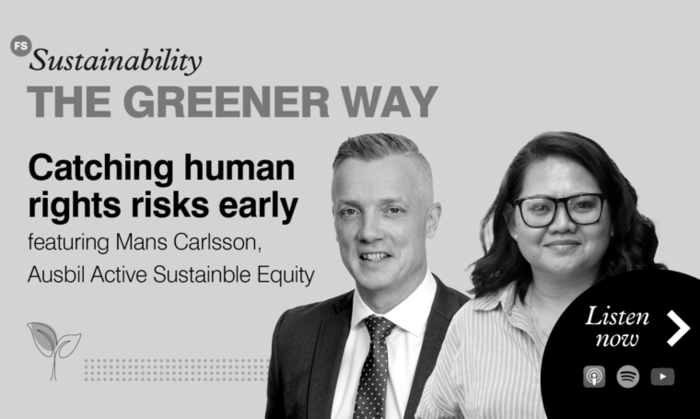 Why does modern slavery persist despite Australia's Modern Slavery Act, and what practical steps can investors and fund managers take to drive real change beyond compliance? Related News |


Editor's Choice
ASIC observes improvement in climate disclosures
ASIC has observed an increase in the quality, quantity, and consistency of climate-related financial information with the introduction of statutory sustainability reporting requirements.
NRFC names new Net Zero Fund head
The National Reconstruction Fund Corporation (NRFC) has appointed Laren McGregor as head of its Net Zero Fund, where she will oversee the investments aimed at helping emissions-intensive industries decarbonise and domestic manufacturers of low-emissions technologies scale up.
Foresight draws super funds' attention in new investment
Foresight Group has raised $660 million from institutional investors, including super funds, to support rising public transport demand.
ARENA launches $30m startup fund
The Australian Renewable Energy Agency (ARENA) has launched a new $30 million funding program to help early-stage technologies from development towards commercialisation.
Videos
Brought to you by ![]()

Further Reading
Whitepapers

Modern slavery in the geopolitical crossfire
When investors frame the conversation about the risks of modern slavery, we tend to cite a common set of facts and a common set of arguments as to why ...

What ACCR v Santos means for your climate disclosures
The Federal Court has dismissed greenwashing claims brought by the Australasian Centre for Corporate Responsibility (ACCR) against Santos.

Materiality is not a single judgment: It is a governance system
Much has been written about sustainability materiality in recent years. The more fundamental problem is that materiality is still treated as a single ...

Roundtable reflections: Is ESG dead?
"Is ESG dead?" we asked at our recent Responsible Investors (RI) roundtable in May this year. Short answer: no.
Expert Feed

Australia's social media age ban: A digital turning point for society and investment markets
In a global first and a warning shot for platforms, at the end of 2025 Australia became the first country to ban under-16s from social media, with penalties ...

How economics and energy security are driving the next phase of the energy transition
Looking ahead, the next phase of the energy transition will be defined by practical system build-out rather than headline climate commitments.

Sustainability in 2025: Building resilience and navigating risks
In 2025, there is likely to be much scrutiny around US President Donald Trump's anti-green agenda in particular.

Balancing Investor expectations with entrepreneurial growth
Recent headlines highlighting corporate management shortfalls in companies led by their founders underscore the need for rigorous governance standards.
ACCESS MORE CONTENT
Financial Standard
Australia's most-read trade publication for wealth management professionals.