



Podcast: Ethinvest on impact and shareholder activismBY THE GREENER WAY | TUESDAY, 22 SEP 2026 10:28AM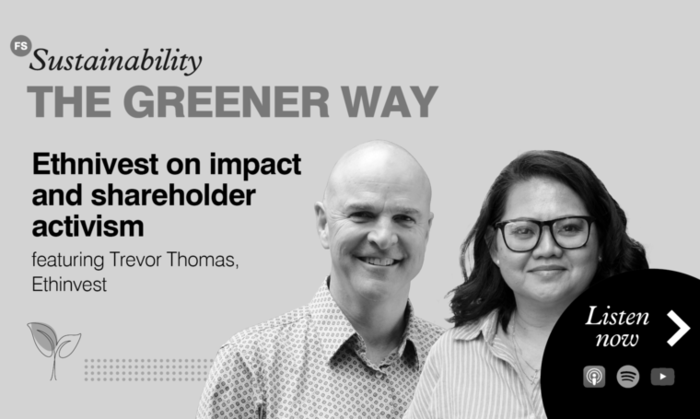 🔥 Ethinvest: A call to make impact investing accessible for everyday Australians ❓ Question: Impact investing has matured significantly over the past decade, but many of the most attractive opportunities remain out of reach for everyday investors. What is changing in the impact investing landscape, and how can investors use both their capital and their shareholder influence to create positive environmental and social outcomes? ✅ Answer: According to Trevor Thomas, managing director of Ethinvest, impact investing is evolving from a niche market into an increasingly sophisticated asset class that is attracting institutional-grade fund managers and larger pools of capital. While impact investing has traditionally been dominated by wholesale investors, efforts are underway to make high-quality impact opportunities more accessible to retail investors. Thomas explains that true impact investing differs from simply buying shares in companies with positive environmental or social credentials. Impact investments are intentionally designed to address a specific problem, measure the outcomes achieved and provide capital directly to projects that generate positive change. This can include renewable energy, affordable housing, environmental restoration and social impact initiatives. Alongside capital allocation, Thomas argues investors should not underestimate the power of shareholder engagement. Over the past decade, shareholder activism and engagement campaigns have helped drive change across issues including climate disclosure, gambling, plastic waste, deforestation and biodiversity protection. Investors increasingly have two powerful tools available: where they invest their money and how they use their voice as shareholders. 🌟 Impact investing is becoming more institutional and mainstream The first generation of impact investments was often innovative but relatively small in scale. Today, institutional fund managers are launching larger, more diversified impact funds with the potential to deliver market-like returns while creating measurable environmental and social outcomes. 🌟 True impact investing goes beyond buying ethical shares Thomas distinguishes impact investing from traditional share investing. When investors purchase listed shares, the money typically goes to another shareholder. Impact investments, by contrast, direct capital towards creating new projects, assets and solutions that address social or environmental challenges. 🌟 Renewable energy and environmental infrastructure remain major themes Some of the most prominent opportunities today include renewable energy infrastructure, battery storage, environmental water projects and decarbonisation initiatives. These investments are attracting increasing interest as governments, institutions and investors seek practical solutions to sustainability challenges. 🌟 Democratising impact investing remains a key goal One of the biggest challenges facing the sector is accessibility. Many of the highest-quality impact funds remain restricted to wholesale investors. Thomas says efforts are underway to create investment vehicles that combine leading impact funds into structures that retail investors can access more easily. 🌟 Superannuation funds could play a larger role Large super funds are increasingly allocating capital towards impact investments and are becoming more active participants in addressing challenges such as climate transition, clean technology development and affordable housing at scale. 🌟 Shareholder activism can drive meaningful change Investor engagement has played a significant role in influencing corporate behaviour. Thomas highlights campaigns involving climate change, banking policies, biodiversity protection, plastic reduction and gambling exposure, demonstrating that investors can create change even when shareholder resolutions do not ultimately succeed. 🌟 Success is not always measured by winning the vote Some engagement campaigns fail to achieve immediate outcomes but still generate important progress. Thomas points to climate-related shareholder advocacy that led companies to improve transparency and disclose previously unavailable information, helping investors better understand risks and corporate strategies. 🚩 Retail investors still face access barriers Many impact investments involve long investment horizons of seven to ten years. These illiquid structures can be difficult for retail investors to access, creating a gap between investor demand and available products. 🚩 Patience is often required Unlike publicly traded shares, many impact investments require investors to commit capital for extended periods before outcomes and returns are realised. This remains one of the sector's biggest structural challenges. ⚠️ Not every impact investment succeeds While many impact investments have generated positive outcomes and competitive returns, others have faced challenges. Some projects were disrupted by external events such as COVID-19, highlighting the importance of diversification and careful manager selection. ⚠️ Impact measurement remains critical As the sector grows, investors need confidence that managers are measuring and reporting outcomes consistently. Intentionality, measurable impact and additionality remain key characteristics that distinguish genuine impact investments from broader sustainability strategies. 🌟 Investors no longer need to sacrifice returns Thomas believes one of the industry's biggest misconceptions is that ethical and impact investing inevitably leads to weaker financial performance. In most asset classes, investors can now access strategies that seek both commercial returns and measurable impact outcomes. 💡 Why it matters: Impact investing is moving beyond its early experimental phase and becoming a more established part of the investment landscape. As institutional managers bring larger, more sophisticated products to market, access is gradually expanding and the opportunity set is widening. At the same time, investors are increasingly recognising that creating impact is not just about where money is invested, but also how shareholder rights are exercised. Understanding both capital allocation and engagement strategies may become increasingly important as investors seek to balance financial outcomes with positive environmental and social change. 🎙️ Sources: Trevor Thomas, managing director, Ethinvest Michelle Baltazar, host, The Greener Way ⏱️ Timestamps: 00:00 - Why impact investing needs to be democratised 00:17 - The evolution of impact investing 01:33 - What makes an investment a true impact investment 03:02 - Standout impact funds and recent opportunities 04:02 - The challenge of retail investor access 05:00 - Wholesale versus retail impact investing 06:38 - The role of super funds in driving impact 07:23 - Shareholder activism and investor influence 08:41 - Using shareholder resolutions to create change 10:07 - Lessons from climate engagement campaigns 11:00 - Biodiversity and salmon farming advocacy 11:49 - Impact investment performance and outcomes 12:37 - Why scale matters in impact investing 13:29 - The myth that impact investing underperforms 14:08 - Final thoughts and key takeaways 🌿 We record on Gadigal Land and pay our respects to the traditional custodians of country and elders past and present. Related News |


Editor's Choice
ASIC observes improvement in climate disclosures
NRFC names new Net Zero Fund head
Foresight draws super funds' attention in new investment
ARENA launches $30m startup fund
Videos

Whitepapers

Modern slavery in the geopolitical crossfire

What ACCR v Santos means for your climate disclosures

Materiality is not a single judgment: It is a governance system

Roundtable reflections: Is ESG dead?
Expert Feed

Australia's social media age ban: A digital turning point for society and investment markets

How economics and energy security are driving the next phase of the energy transition

Sustainability in 2025: Building resilience and navigating risks

Balancing Investor expectations with entrepreneurial growth