

Podcast: Funding gap in blue bondsBY THE GREENER WAY | TUESDAY, 10 NOV 2026 10:37AM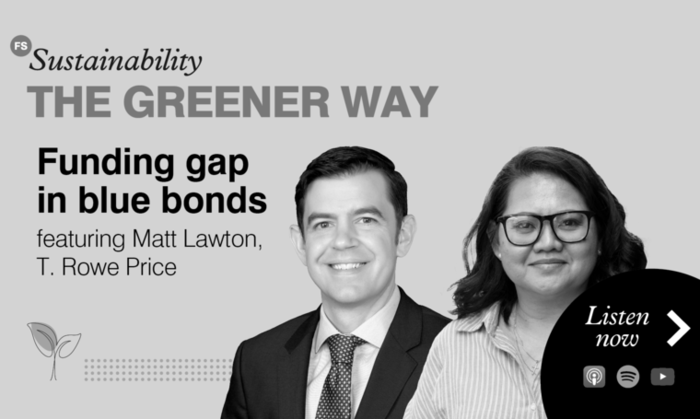
🌊 Can blue bonds deliver impact without sacrificing returns? ❓ Question: Impact investing is often associated with shares and private markets, but can bond investors also generate measurable environmental and social outcomes while still achieving competitive financial returns? ✅ Answer: According to Matt Lawton, head of impact fixed income and portfolio manager at T. Rowe Price, impact investing in fixed income does not require investors to sacrifice returns. Instead, impact and financial performance can work together when capital is directed towards projects with strong fundamentals and measurable outcomes. Lawton says bond markets are increasingly being used to finance climate resilience projects, water infrastructure, blue economy initiatives and environmental restoration programs. Examples include a World Bank-backed Amazon reforestation bond, where investor returns are linked to the achievement of environmental outcomes, and climate resilience bonds that help communities prepare for extreme weather events. He argues that one of the most powerful concepts in impact investing is additionality, where investors help create outcomes that may not otherwise occur. This can include educating issuers on how to structure blue bonds, attracting new sources of capital into sustainability projects and funding innovative environmental technologies. Lawton also believes water security is one of the most underfunded opportunities in sustainable finance. Despite its importance to environmental and social outcomes, only a small proportion of green bond proceeds are currently directed towards water and wastewater projects. 🌟 Key insights: 🌟 Impact investing in fixed income can pursue financial returns and measurable impact simultaneously. 🌟 Bond markets are helping finance climate resilience, water security and environmental restoration projects. 🌟 The Amazon reforestation bond links investor returns to environmental outcomes. 🌟 Climate resilience bonds can fund flood defences, water storage and infrastructure upgrades. 🌟 Measuring outcomes is critical, with projects assessed through specific impact KPIs. 🌟 Water and sanitation remain among the most underfunded UN Sustainable Development Goals. 🌟 Blue bonds are emerging as a way to channel capital into oceans, water infrastructure and marine conservation. 🌟 Additionality focuses on creating outcomes that would not otherwise occur without investor involvement. 🌟 Investors can play a role in bringing new sustainability projects and issuers to market. 🌟 Strong environmental performance can also be a sign of stronger long-term business fundamentals. 🚩 Risks: 🚩 Climate resilience and environmental projects may face long development timelines. 🚩 Measuring real-world impact remains complex and requires credible reporting frameworks. 🚩 Blue bond markets are still relatively small and developing. 🚩 Investors need confidence that proceeds are directed towards genuine environmental outcomes. 🚩 Infrastructure and climate-related projects remain exposed to regulatory and operational risks. 🚩 Sustainability-labelled bonds may face scrutiny if impact outcomes are poorly measured or communicated. ⚠️ Things to watch: ⚠️ Growth in climate resilience bonds and adaptation-focused financing. ⚠️ Expansion of the global blue bond market. ⚠️ Increased investor demand for measurable impact outcomes. ⚠️ New structures linking financial returns directly to environmental performance. ⚠️ Greater private-sector participation in water security and marine conservation projects. ⚠️ Development banks continuing to support innovative sustainability financing models. ⚠️ More focus on additionality as a key measure of impact investing success. 💡 Why it matters: Much of the discussion around sustainable investing focuses on equities, but bond markets represent a far larger pool of capital globally. As investors search for ways to finance climate adaptation, water security and environmental restoration, fixed income markets could play an increasingly important role. For investors, the growth of blue bonds and resilience bonds may provide opportunities to support measurable environmental outcomes while maintaining competitive risk-adjusted returns. 🎙️ Sources: Matt Lawton - head of impact fixed Income and portfolio manager, T. Rowe Price Michelle Baltazar - host, The Greener Way ⏱️ Timestamps: 00:15 - Why impact investing isn't just about equities 01:27 - Managing impact-focused fixed income strategies 03:45 - Building the blue bond market with the IFC 04:20 - How bond investors support climate resilience 05:00 - The Amazon reforestation bond explained 06:00 - Linking investor returns to environmental outcomes 07:05 - Impact investing and return expectations 08:00 - Infrastructure investing versus resilience investing 08:37 - Tokyo's climate resilience bond case study 11:00 - Why water security is underfunded 12:18 - Investing in blue bonds without sacrificing returns 13:07 - Understanding additionality in impact investing 15:00 - Bringing new sustainability projects to market 16:34 - Funding coral reef restoration through blue bonds 18:16 - Responding to impact investing sceptics 20:08 - Why impact and returns can reinforce each other Links: https://www.troweprice.com/financial-intermediary/au/en/lp/esg/blue-economy.html 🌿 We record on Gadigal Land and pay our respects to the traditional custodians of Country and elders past and present. Related News |


Editor's Choice
Two-strike remuneration rule remains effective: ACSI
UN-backed investor alliance sets climate targets for private markets
Non-profit urges Australia to step up ahead of COP31
Future Group finalises change of trusteeship
Videos

Whitepapers

Modern slavery in the geopolitical crossfire

What ACCR v Santos means for your climate disclosures

Materiality is not a single judgment: It is a governance system

Roundtable reflections: Is ESG dead?
Expert Feed

APAC's CCS challenge is no longer recognition. It is investment.

Navigating the climate and biodiversity frontier

Embracing complexity for sustainable returns

Australia's social media age ban: A digital turning point for society and investment markets